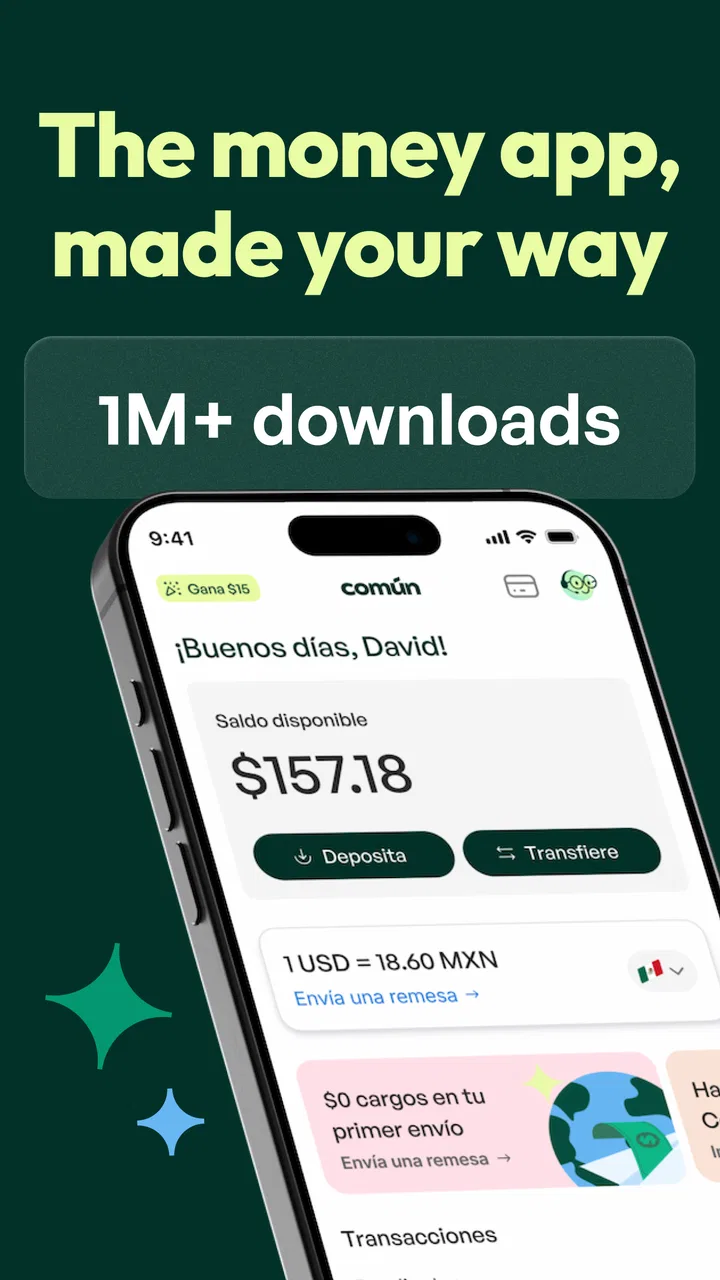
Común: Your money, your way
- 4.8
- Rating
- 500.00K
- Installs
- Free
- Price

 Analysis by App-foxy
Managing money across borders is one of those jobs that looks simple until you actually need to do it. You may be paid in the United States, support relatives in Latin America, and still want one card for everyday spending. That is the situation where I found Común most interesting. It is a free finance app from Comun built around sending money to Latin America, paying other people, and using a Visa debit card rather than juggling several unrelated services.
My first impression is that Común is less about replacing every financial tool you use and more about creating a practical bridge between receiving, sending, and spending money. The app has a 4.7 average from around 18 thousand ratings, with more than 500 thousand installs, which suggests it has found a real audience. Those figures do not automatically make it right for everyone, but they do make it easier to take seriously as an everyday money app rather than a niche experiment.
The best way to understand Común is to follow the money from the moment you decide to send it to the moment the other person can use it. That workflow also reveals its limits. It is convenient when your needs match its central purpose, but it may feel narrow if you want a complete banking replacement, complex budgeting, or a broad investment platform.
You May Also Like

 Blood Strike: 2.5 Anniversary
Blood Strike’s Loadouts Turn Every Drop Into a Tactical Gamble
A close look at Blood Strike’s custom loadouts: how fast access to signature weapons reshapes its battle royale rhythm, rewards preparation, and narrows the gap between fights.

 Pandora - Music & Podcasts
Pandora’s Music Is Easy to Start, but Harder to Recover
Pandora’s strength is its low-effort path from a seed to a station. Its weak spot is how much confidence it asks you to place in connection, setup, and quiet recovery.

 8 Ball Pool
 Is Built on Rivalries, Rematches, and Routine
A close look at the rivalries, rematches, shared routines, and unanswered safety questions that turn a quick pool match into a persistent mobile community.

 Samsung Music
’s Quiet Strength Is Playing What You Already Own
Its reach comes less from spectacle than from dependable access to a personal library. That simplicity is both the app’s strongest retention engine and its ceiling.

 AccuWeather: Weather Radar
AccuWeather Review: A Quick, Clear Forecast for Everyday Decisions
For everyday plans, the best forecast is the one you can understand quickly. AccuWeather makes rain timing, radar, and local conditions easy to act on, with a few trade-offs.

 Hill Climb Racing
Why Hill Climb Racing Still Turns Crashes Into One More Run
A tiny car, a bumpy hill and one more upgrade: Hill Climb Racing keeps resurfacing because its simple chaos makes every near-miss feel personal.
More From Our News Desk



From a payment decision to money someone can use
When I think through the payment journey, the key question is not just whether I can send money, but whether the recipient can put it to use without confusion. I’d treat clear recipient details and a quick confirmation as part of the transaction, especially when the payment supports a specific expense. That practical handoff sets up the next section’s look at how the app fits into everyday sending and spending.
Starting with the real problem
Imagine that I need to help a family member in Latin America while also keeping my own spending organized. With a traditional setup, I might use one service for international transfers, another app for payments, and a separate bank card for purchases. Every extra handoff creates another place to check balances, confirm recipients, or wonder whether the money has arrived.
Común approaches that situation from a more focused angle. Its store summary describes paying anyone, sending money to Latin America, and getting a Visa debit card. In practical terms, that means I can look at it as a single workflow: choose the person or destination, move the money, and use the card for the part of my financial life that happens locally.
The app is free to install, and its content rating is Everyone, so it is presented as an accessible tool rather than a specialist product for professional finance users. The developer is Comun, and the app was released on August 30, 2022. I would still treat any financial app as something that deserves careful checking before a large transfer, but the basic proposition is easy to understand.
Preparing the transfer instead of rushing it
My first useful habit with an app like this would be to prepare the transaction before entering the final amount. I would confirm the recipient’s details, decide whether the payment is for a regular obligation or one-time help, and check the receiving side with the person who will use the money. This sounds obvious, but international transfers are exactly where a small spelling error or an outdated contact can turn a quick task into a support conversation.
Común makes the most sense when I already know the recipient and the purpose. It is not the tool I would choose for casually exploring exchange markets or moving money to an unknown business. The human handoff matters: I need the other person to recognize the transfer, know when to expect it, and tell me if something looks wrong.
A useful workflow is to send a small amount first when I am helping someone for the first time. That is not a claim about a special Común feature; it is simply good practice for any cross-border service. A small test can expose an incorrect recipient detail without putting the whole household budget at risk. Once the route works, recurring support becomes easier to repeat because the people and purpose are already familiar.
Using the app for more than one kind of payment
The phrase “pay anyone” gives Común a broader role than a transfer-only service. I can imagine using it for a personal reimbursement, sending money to a relative, or settling a shared expense. That flexibility is useful because not every payment to Latin America has the same emotional or practical context. A family contribution may require a message and confirmation, while a friend paying me back is a much smaller, more casual exchange.
Still, I would avoid treating every payment as interchangeable. A transfer to a relative, a purchase from a business, and a reimbursement between friends can have different expectations around timing and proof. I would keep my own note of the amount and purpose, especially for recurring support. The app can help move the money, but it does not replace my responsibility to keep a simple record.
The Visa debit card as the spending handoff
The Visa debit card is the part that connects the transfer workflow to daily spending. Instead of sending money out and then switching to another card for purchases, I can use the card associated with the service for ordinary transactions. That could be useful for someone who wants a dedicated spending channel for money managed through Común.
In my view, the card is most valuable when it gives a clear boundary to a particular purpose. For example, I might use it for travel spending, household purchases, or money I set aside for a relative’s expenses. A separate card can make it easier to see what belongs to that purpose without mixing everything into my main bank account.
There is also a trade-off. A dedicated debit card is not automatically a complete replacement for a primary bank card. I would want a backup payment method for situations where a card is not accepted, a transaction needs extra verification, or I need a financial feature outside Común’s central workflow. The sensible approach is to use the Visa card as a useful part of my setup, not assume it must be the only one.
Following the money through the handoffs
The most important handoff is between me and the recipient. I start with an intention, enter the details, and then depend on another person to confirm the outcome. That is where clear communication helps more than speed. I would tell the recipient the amount I sent, the reason for it, and when I expect them to check. If the money is for a bill, I would ask them to confirm that the bill was actually covered rather than assuming that a completed send equals a completed real-world outcome.
The second handoff is between the app and the card transaction. Sending money and spending with a Visa debit card are related, but they are not the same action. I would keep an eye on which balance or purpose I am using before paying. This matters especially when I have money intended for someone else. A quick purchase can become an accounting problem if I mentally treat all available funds as personal spending money.
The third handoff is between Común and my wider financial life. I may still receive income elsewhere, pay bills through another provider, or keep savings in a traditional bank. Común can fit into that arrangement, but I need a routine for moving only the amount I intend to use. I prefer a controlled transfer into a spending tool over treating a secondary app as an unlimited pool of cash.
A realistic everyday scenario
Suppose I want to help a family member with a monthly household expense. On the morning I plan to send it, I would first contact the person and confirm that the destination details have not changed. I would then open Común, choose the payment or sending workflow, review the recipient, and enter the amount carefully. Before completing the action, I would compare the displayed information with the message I received from my family member.
After sending, I would tell the recipient to check on their side and keep a note of the transaction. If the money is meant to cover groceries or transportation, the recipient can use it for that immediate need. If I also need to buy something during the day, I could use the Visa debit card for my own purchase, while keeping the family transfer separate in my records.
At the end of the day, the outcome I want is not merely “the app accepted the transaction.” I want the recipient to have usable money, my own card purchase to be understandable, and the amount I sent to remain easy to reconcile later. That is where Común’s combined concept is helpful: the sending and spending tasks can live close together, even though I still need to manage the human and financial details around them.
Where the workflow can break
The biggest weakness of any money app is that a clean interface cannot eliminate real-world uncertainty. A recipient may not check promptly, a detail may be entered incorrectly, or the person receiving the money may need to use a different method for a particular expense. I would not send an urgent bill payment at the last possible moment simply because the app makes the action feel quick.
Another possible source of friction is expectation. Someone looking for a full bank account experience may be disappointed if their needs extend far beyond sending, paying, and debit-card spending. Común is not the obvious choice for advanced financial planning, investment research, or a highly detailed household budget. For those jobs, a traditional bank, dedicated budgeting app, or specialist service may be better suited.
I would also skip it if my main requirement is a very broad international setup covering many unrelated destinations and financial products. Común’s identity is strongest around payments and Latin America. If my regular money movement does not involve that use case, the app may add another account to maintain without solving a meaningful problem.
What I would check before relying on it
Before making Común part of a regular routine, I would test the complete cycle with a modest amount: sending, recipient confirmation, and a small card purchase. This tells me whether the workflow fits my habits, not just whether the app looks convenient in the store. I would also decide where I keep transaction notes and how I will handle a payment that needs clarification.
I would not assume that “free” means every possible financial action has identical conditions. The app itself is free, but responsible users should still review the details shown during a transaction and understand what they are agreeing to before confirming. That is particularly important for international money movement, where the amount a recipient can use may be affected by the route and local circumstances.
Security habits matter just as much as the interface. I would use a strong device lock, avoid sending sensitive account details through casual messages, and verify unexpected requests directly with the recipient. These precautions are not unique to Común, but the app’s convenience makes them worth emphasizing: the faster a payment feels, the easier it is to skip a final check.
How it compares with familiar alternatives
Compared with a conventional bank, Común feels more focused on the handoff between people and on cross-border support. A bank may offer a wider range of accounts and services, which is useful if I want one institution to handle savings, bills, loans, and long-term planning. Común is more appealing when the immediate task is paying someone or sending money to Latin America without making that task part of a large banking relationship.
Compared with a transfer-only service, the Visa debit card gives Común a more complete day-to-day role. I am not only initiating a payment; I can also use the card for spending. The trade-off is that a specialist transfer service may be a better fit for someone who wants to compare destinations, routes, or transfer-specific options in depth. My choice would depend on whether I value one connected workflow more than specialized breadth.
Compared with a peer-to-peer payment app, the Latin America focus is the meaningful distinction. A general payment app may be excellent for splitting dinner with local friends, but it may not match the needs of someone supporting family abroad. On the other hand, if nearly all my payments are domestic and I already have a card I like, Común may not offer enough additional value to justify changing routines.
Who will get the most from Común
I would recommend Común to someone who regularly sends money to Latin America, wants a straightforward way to pay people, and likes the idea of a Visa debit card connected to that financial routine. It is also a reasonable option for someone who wants a separate spending channel for a defined purpose, such as travel or family support.
The app is less convincing for users who want a complete replacement for a bank or who need sophisticated financial organization. I would also be cautious about relying on it as my only payment method. A backup card and a simple record of important transfers are sensible even when the normal workflow is smooth.
The current version is 2.14.0, and the listed minimum operating-system requirement is version 10. That makes compatibility something to check before installing, especially on an older phone. Since the app is rated for Everyone and costs nothing to download, trying the workflow with a controlled amount is a practical way to decide whether it belongs in my routine.
My final take after following the whole journey
Común succeeds when I judge it by the complete journey rather than by one isolated feature. I can begin with a need to pay or support someone, move through the recipient handoff, and finish with money that can be used through a Visa debit card. That connected path is more useful than a generic promise of convenience because it addresses a specific situation many people actually face.
Its limitations are equally clear. I still need to verify recipients, communicate after sending, keep track of purpose, and maintain another option for unusual or urgent situations. The app does not remove those responsibilities, and it should not be treated as a universal financial command center.
Overall, I see Común as a focused, practical choice for people whose money routine includes Latin America and everyday debit-card spending. If that describes you, I would give it a careful trial and start with a small, well-understood transaction. If your needs are mainly local, highly specialized, or centered on full-service banking, a traditional bank or a more specialized alternative may serve you better.
For the right user, the strongest benefit is simple: fewer disconnected steps between deciding to send money and seeing that money become useful. That is a modest promise, but in my experience, reducing confusion at those handoffs can make a meaningful difference.
FAQs for Común: Your money, your way
01What is Común and how can it benefit me?
Común is a financial management app designed to help users manage their money effectively. It offers features such as budgeting tools, spending trackers, and personalized financial advice. By using Común, you can gain insights into your spending habits, set financial goals, and make informed decisions to improve your financial health.
02Is Común safe to use for managing my finances?
Yes, Común prioritizes user security by employing advanced encryption technologies to protect your personal and financial data. The app complies with industry standards and regulations to ensure your information is safe. Additionally, Común does not share your data with third parties without your consent, keeping your financial information private.
03What platforms is Común available on?
Común is available for both Android and iOS devices. You can download it from the Google Play Store for Android or the App Store for iOS. The app is optimized to provide a seamless user experience across different devices, allowing you to manage your finances on the go.
04Does Común offer support for multiple currencies?
Yes, Común supports multiple currencies, making it suitable for users who manage finances in different regions. The app allows you to set your preferred currency and easily convert between various currencies, providing a flexible solution for international users or those dealing with global transactions.
05Are there any subscription fees or in-app purchases in Común?
Común offers a free version with essential features for basic financial management. However, there are premium subscription options available that unlock additional features such as advanced analytics, personalized financial coaching, and exclusive tools. Users can choose the plan that best suits their needs and budget.
Pros
- User-friendly interface for easy navigation.
- Customizable alerts for spending limits.
- Integration with multiple bank accounts.
- Secure encryption for data protection.
- Real-time transaction updates.
Cons
- Limited support for international currencies.
- Some features require premium subscription.
- Occasional syncing issues with accounts.
- No offline access to transaction history.
- Minimal customer support responsiveness.

Común: Your money, your way
Gallery